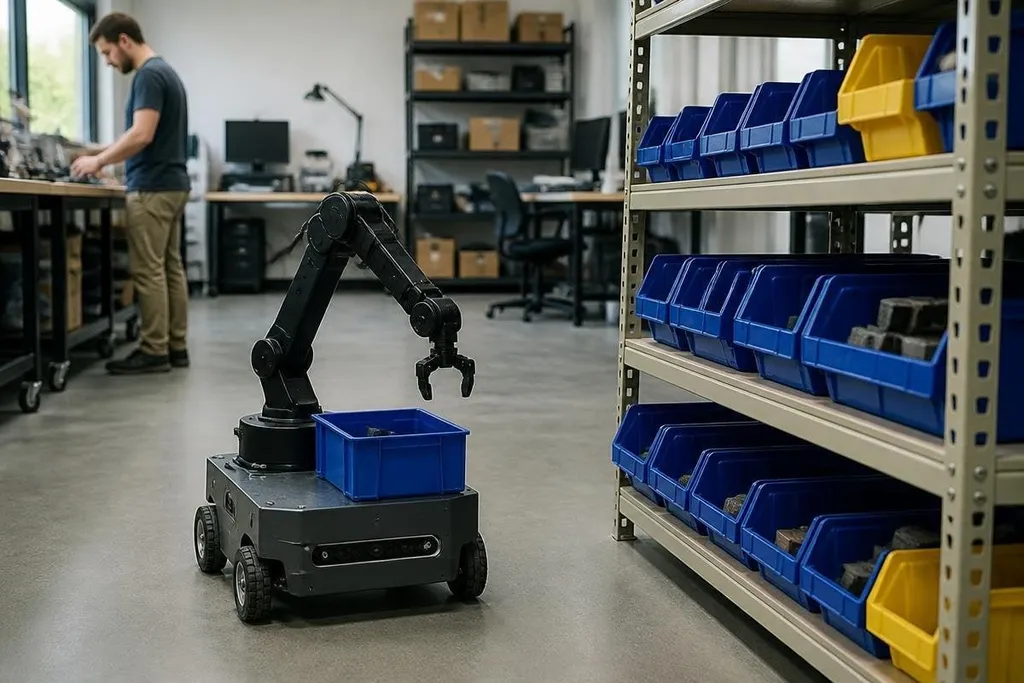
A robot can cost less when its job stays small, its surroundings stay known, and a person handles the rare failures. That trade-off is changing who can test automation, but it also puts clear limits on what a low-cost system can do.
- Small tasks need fewer sensors and less software
- Cameras, motors, and grippers still need careful setup
- The real cost includes wiring, safety, maintenance, and staff time
What makes a robot low-cost
A low-cost robot usually cuts expense through simpler hardware or open software. A small arm may use stepper motors instead of costly servo systems, while a mobile robot may use wheel encoders and a camera instead of a larger sensor package.
Those choices work when the task repeats in a known space. A robot that moves parts between two fixed points needs less sensing than one that must find mixed objects on a busy floor. The first task has fewer decisions, so the system needs fewer ways to measure the world.
The savings can also come from the control software. Open-source tools such as ROS 2 let a team connect cameras, motor drivers, and sensors without writing every layer from the ground up. That can cut license costs, but the team still needs someone who can set up, test, and fix the system.
Where the lower price helps
Small manufacturers, schools, and research teams can use lower-cost robots to test one task before buying a larger system. A camera can check whether a part is present. A gripper can move a repeatable object. A wheeled platform can carry a load across a marked route.
Each example has the same shape: the robot gets a narrow job, clear limits, and a known handoff. That makes failure easier to spot. It also lets a technician change one part at a time, such as the gripper or the camera, instead of rebuilding the whole system.
Price comparisons need more than the robot’s list price. Installation, safety checks, software, and service can decide whether a low-cost system fits the job. Robot24 reports on machines and deployments, giving industry readers a way to place those costs beside the hardware before the next section looks at what remains after purchase.
The costs that stay behind
The purchase price doesn't remove the work around the robot. Someone must mount the hardware, route cables, write task logic, set safe speeds, and check what happens when an object is missing.
The gripper often decides whether the project works. A tool made for one box or tray may fail when the item changes shape, weight, or surface.
A camera can find an object in steady light, then lose it when glare or shadows change.
Safety adds more hardware and planning. A system near people may need an emergency stop, guarded motion, speed limits, and a clear way to restart after a stop. An arm that cannot meet the site's safety needs is not a low-cost project.
I’d buy a low-cost robot for a fixed task with a clear failure handoff, and skip it for open-ended work around people.
What remains unproven
A short demonstration proves that the robot completed one run. It doesn't prove that the same task will work through a full shift, after a tool wears, or when materials arrive in a different position.
The missing test is repeatability under normal mess. Check how often the robot stops, how long a person takes to fix it, and what happens after a power loss. Those results matter more than a fast cycle shown once.
A team should also check software support. One controller may depend on a community project or a driver that no longer receives updates. That risk can turn a small saving into a long repair job.
A buying check for small teams
Use this list before choosing hardware:
- Name one task: Write the exact action, object, start point, and handoff.
- Set the limits: Record the object weight, size range, speed, light level, and working area.
- Plan the stop: Decide who responds when the robot drops an item or loses its position.
- Count the extras: Add sensors, grippers, mounts, wiring, safety parts, software, and training.
- Run a long test: Measure stops and repairs across repeated work, not one successful cycle.
- Check support: Confirm that parts, code, manuals, and replacement motors will remain available.
This process keeps the price question tied to the task. It also shows when a basic robot has reached its limit and a more capable system is needed.
Low-cost robotics will spread through small trials before it reaches harder work. The useful question for each project is narrow: can this machine repeat one job safely, with a person ready when it cannot?